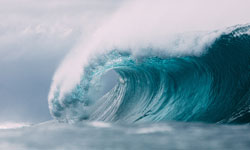
A tsunami carries the energy of an earthquake across an entire ocean and delivers it, undiminished, onto a beach full of people.
The wall of water
Most tsunamis are born when a seafloor earthquake suddenly displaces a vast column of water. In the deep ocean the wave is barely noticeable and travels as fast as a jet; as it reaches shallow coastline it slows, stacks up, and surges ashore.
It arrives not as a single curling wave but as a fast, relentless flood that keeps coming. The 2004 disaster was so deadly partly because the Indian Ocean had no warning system and few people recognized the danger.
“If the ground shakes near the coast, don't wait for a siren — climb.”
Nature's own warning
The single most important tsunami fact is also the simplest: strong shaking near the coast is the warning. Often the sea withdraws dramatically first, exposing the seafloor — a deadly invitation that has lured the curious to their deaths.
For a locally generated tsunami there may be only minutes. No official alert can beat the wave; your own legs are the warning system. Move to high ground or inland, on foot, immediately.
The Cascadia tsunami
A Cascadia megathrust earthquake will generate a tsunami that reaches the Oregon coast in as little as 15 minutes — far faster than any official warning could help. Communities from Astoria to Brookings sit in the inundation zone.
Inland Portland is not at tsunami risk, but anyone who visits the coast should treat strong, long shaking as the only warning they will get: drop, hold on, then immediately move to high ground.
Knowing your zone before you need it
If you live, work, or vacation on the coast, learn the inundation map and the marked evacuation routes before you arrive. Walk the route to high ground at least once.
The difference between survivors and victims is usually nothing more than knowing which way to run — and not hesitating.