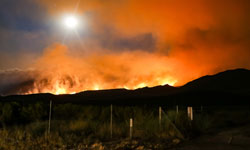
For years the 2020 Labor Day fires were the benchmark for a catastrophic Oregon fire season. In 2026 the state passed every acreage record it had.
The numbers
As of September 22, compiled state and federal figures put Oregon's 2026 season at more than 2.5 million acres burned across more than 1,800 fires. That is roughly a million acres beyond the previous record, set in 2024. Figures continue to be revised as fires are mapped and closed out.
The largest fires of the year:
- Big Grass Fire: a lightning-caused fire that started July 23 and grew to roughly 578,000 acres along the Oregon–Idaho line. It is the largest wildfire in Oregon's recorded history.
- Rowe Creek Complex: roughly 374,000 acres.
- Coleman Creek Fire: roughly 309,000 acres.
- Austin Fire: about 12,900 acres on the Mount Hood National Forest, close enough to the metro area to feel personal.
Most of the acreage burned in rangeland and forest east of the Cascades, but smoke from those fires repeatedly drifted west over the Willamette Valley through the summer.
Where it stands now
Rain and cooler weather in early September slowed growth on several national forests, and fall weather is now doing what firefighters couldn't: bringing the season to a close. Some large fires will smolder in remote areas until winter rain fully puts them out.
For current fire status near you, check InciWeb, the Oregon Department of Forestry's fire information page, and your county's emergency alerts.
Smoke is the hazard most of us will face
Even if fire never comes near your home, smoke will. In 2020, Portland briefly had some of the worst air quality on Earth. Fine smoke particles (PM2.5) get deep into the lungs and are especially hard on children, older adults, pregnant people, and anyone with asthma or heart disease.
The off-season is the cheapest and easiest time to prepare: masks, filters and air purifiers are in stock and often on sale.
Get ready for next season now
- Make a clean-air room. One room with the windows shut and a HEPA air purifier sized for the space. A box fan with a MERV-13 furnace filter strapped to it is a well-tested low-cost alternative.
- Stock N95 masks. Cloth and surgical masks don't filter smoke particles. N95s do, when they fit snugly.
- Upgrade your HVAC filter. If your system can handle it, a MERV-13 filter catches far more smoke.
- Know the evacuation levels. Oregon uses three: Level 1, Be Ready; Level 2, Be Set; Level 3, Go Now. At Level 2, your car should be packed and pointed out.
- Sign up for alerts. ORAlert and your county's system will reach you faster than the news.
- Harden your home if you live near the wildland edge. Clear gutters, move firewood away from the house, and keep the first five feet around your home free of anything that burns.